Southern Buttermilk Biscuits vs. British Scones: Regional Differences Explained
Set a Southern buttermilk biscuit next to an English scone and the family resemblance is obvious. Both are quick breads, both rise on chemical leaveners rather than yeast, and both are at their best within an hour of leaving the oven. After that, the paths split. One is built for gravy, the other for clotted cream. Knowing which tradition you're cooking in — and why the techniques diverge — is the difference between a batch that tastes right and one that tastes almost right.
One Word, Two Cuisines
Start with vocabulary, because it trips up plenty of home bakers. In Britain, a biscuit is what Americans call a cookie — a crisp, sweet, snap-prone thing. In the American South, a biscuit is a soft, savory quick bread that shows up at breakfast and dinner alike. The closest British equivalent to that Southern biscuit is the scone, though the two are far from interchangeable.
So when a recipe crosses the Atlantic, the words don't travel cleanly. A Southern baker reaching for "biscuit" flour and a British baker reaching for "self-raising" flour are solving different problems with different ingredients.
Flour, Fat, and Sugar: The Ingredient Divide
Southern biscuits begin with soft wheat flour, which is low in protein — often around the level of cake flour. Lower protein means less gluten development, and less gluten means tenderness. Many Southern kitchens keep self-rising flour on hand, which already contains baking powder and salt, then add a pinch of baking soda to react with the buttermilk's acid and give the dough extra lift and tang.
Scones lean on plain or self-raising flour with a higher protein content, plus a small amount of sugar — usually just two or three tablespoons — and often an egg or a splash of cream in the liquid. That sugar and enrichment push them toward a slightly sweet, cakier result.
- Southern biscuit: low-protein flour, buttermilk, baking powder with a little soda, cold butter, shortening, lard, or a blend, and little or no sugar.
- British scone: plain or self-raising flour, milk or cream, baking powder, cold butter rubbed in finely, caster sugar, and optional add-ins like sultanas, currants, or glacé cherries.
- Shared ground: cold fat, a light hand, and a hot oven. Get any of those wrong and both suffer.
Mixing and Shaping: Layers Versus Crumb
This is where the two breads genuinely part company, and it happens at the bench rather than in the bowl.
For biscuits, you cut cold fat into the flour until you still see flat, flour-coated flecks roughly the size of peas. Those flecks become steam pockets in the oven, pushing the dough upward into distinct strata. After the buttermilk goes in, you stir just until a shaggy mass forms, then fold the dough over itself two to four times, patting it flat between folds. That lamination is what gives a good biscuit its pull-apart layers.
Scones take the opposite approach. You rub the butter into the flour with your fingertips until the mixture looks like fine breadcrumbs — no visible flecks, no layers. Add the liquid, bring it together with a knife or a light hand, then knead briefly, just two or three turns, to smooth the surface. The dough is patted into a round about 2 to 2.5 cm (roughly an inch) thick. The goal is an even, tender crumb, not strata.
A biscuit is built to be torn open and covered in something. A scone is built to be split and topped with something.
Cutting, Baking, and the Rise
The cutting step decides how high either one climbs, so treat it with care.
- Chill the dough for 10 to 15 minutes before shaping. Warm dough spreads; cold dough rises.
- Use a sharp cutter and press straight down. Twisting the cutter seals the edges and blocks the rise — the single most common reason for squat biscuits.
- For biscuits, cut with a plain round cutter and set them close together on the pan, nearly touching. Crowding encourages soft-sided, tall biscuits. Space them apart if you want crisp edges.
- For scones, a fluted cutter gives the classic look, and the scones sit spaced apart on the baking sheet. You can also pat the dough into a round and cut it into eight wedges without rerolling.
- Glaze scones with milk or beaten egg for shine. Biscuits usually go in bare, brushed with butter after baking instead.
Oven temperatures are similar but not identical. Biscuits want 220–230°C (425–450°F) for 12 to 15 minutes, until risen and golden on top. Scones bake at around 220°C (425°F) for 10 to 12 minutes. Both should sound slightly hollow when tapped and feel firm at the edges.
The Table Is Where They Part Ways
A Southern biscuit is a savory bread, and it earns its place at the main meal. Split it and fill it with sausage gravy, country ham, fried chicken, or a slice of tomato. Butter and honey work, as does sorghum or cane syrup, but the default setting is salty and rich rather than sweet.
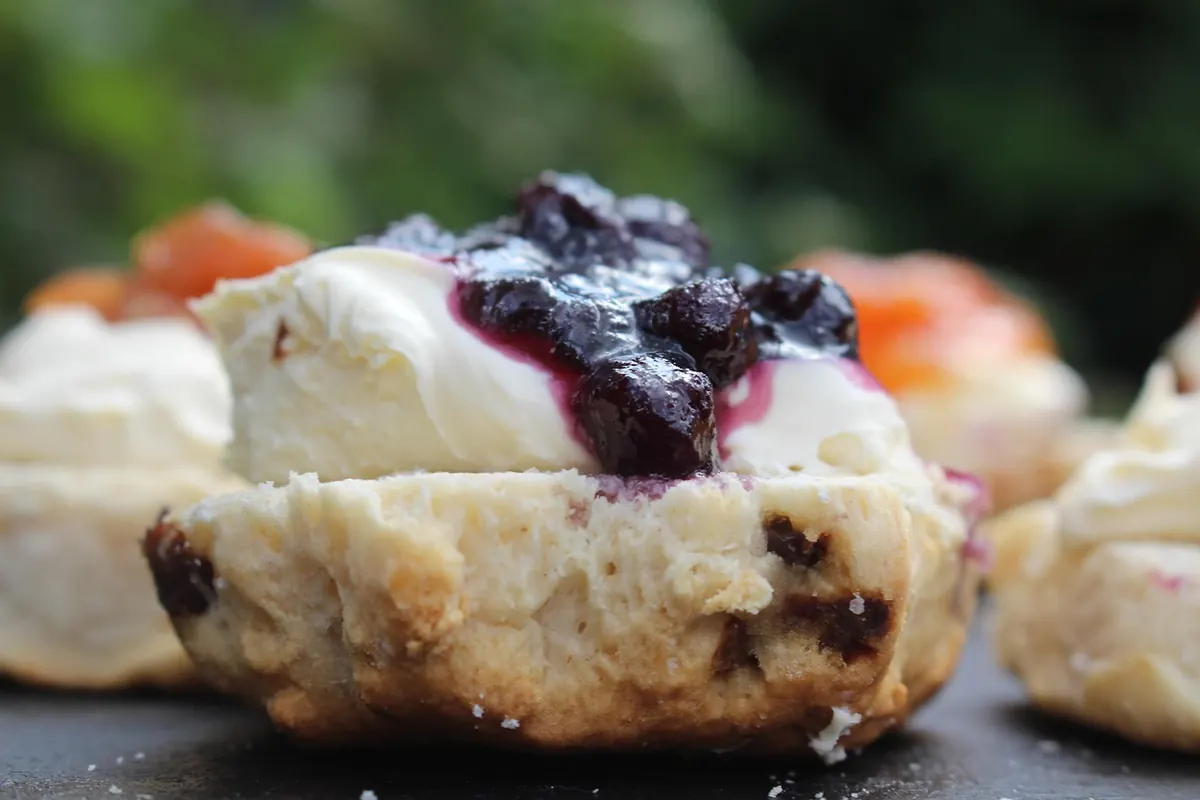
The scone is a tea-table bread. It's split — never sliced clean through like a sandwich — and topped with clotted cream and strawberry jam. Devon and Cornwall have argued for generations about whether cream or jam goes on first, and both counties will insist they're right. Cheese scones and herb scones are the savory exception, often served warm with butter alongside soup.
Practical Notes for Baking Both
Keep everything cold. Freeze your butter for fifteen minutes and grate it on the large holes for biscuits; you'll get even distribution without overworking the flour. If you can't find a low-protein Southern flour, blend all-purpose with cake flour to soften the mix.
Weigh your flour if you can. A cup scooped straight from the bag can weigh far more than a cup spooned and leveled, and heavy flour makes both breads tough. When in doubt, err on the side of less liquid — you can always add a spoonful, but you can't take one out.
Both freeze beautifully. Cut and shape the dough, freeze the rounds on a tray, then bag them. Bake from frozen, adding three to five minutes to the timing. And eat them the day they're made. Neither a biscuit nor a scone improves with age, which is less a flaw than an invitation to bake a smaller batch more often.
Photo: jamstraightuk / Pixabay